
This month MEMO looks at the US mid-term elections, the razing of a Palestinian village in Israel, the continued fallout from the flotilla and much more.
US capitulates to Israel in the shadow of its mid-term elections
- Obama and Netanyahu met this month in a meeting which saw the US administration capitulate to Israel in the shadow of the upcoming US mid-term election. Obama has backed Israeli demands for direct negotiations with the Palestinians. He promised the US would never ask Israel to do anything that undermines its security and praised Israeli restraint over the last month with regard to illegal settlement construction. The pressure has now been turned on the Palestinians.
- Netanyahu is now said to be putting together a list of "concessions" to Palestinians aimed at convincing them to enter direct talks. The main proposed "concessions" will be, inter alia, to widen the responsibility of the Palestinian Authority's security forces, [Israel] to cease operating in Palestinian areas altogether and for a reduction in the number of West Bank roadblocks. Israeli Foreign Minister Avigdor Lieberman has stated that Israel has given enough, the concessions will be put to a vote and it will be difficult to convince the inner 7 ministers of the proposals. Netanyahu has alluded to the possibility of discussing an extension of the settlement freeze which is the central Palestinian demand, but it is contingent upon Palestinians agreeing to direct negotiations first which would render Palestinians' participation in negotiations moot.
- Many Israeli factories have been forced to close, cut production or consider moving back into Israel following the success of a boycott campaign endorsed by Mahmoud Abbas to rid the West Bank of settlement-produced goods by next year and allow the Palestinian economy to become self-sufficient. It forms part of a wider effort toward non-violent resistance against the occupation which is gaining international momentum. Earlier in the month the Methodist Church voted to boycott illegal Israeli settlement goods following a ruling by the European Court of Justice which states that goods from Israeli settlements should not benefit from a trade agreement between Israel and the European Union. The Methodist Church took the decision following numerous calls from Palestinian Christians, Jewish organizations worldwide and the World Council of Churches, among others.
- The campaign has been attacked by the Israeli establishment who say Palestinians are opposing economic peace and an "anti-boycott bill" has been proposed. The bill seeks to outlaw boycotts of Israeli institutions and products, including those in and from settlements and thereby curtail the ability of civil society to criticize government policy. Fines will be imposed on Israeli participants while a 10 year entry ban and a ban on carrying out economic activities will be imposed on foreigners and sanctions will be placed on "foreign political entities" - this targets the Palestinian Authority directly.
- According to the bill, with annulment of prior agreements and laws, money or property due to Palestinians and to the PA will become forfeit and there would be a de jure annexation of the West Bank to Israel. The EU would be deemed a "promoter of a boycott" and Israel could be seen to be in breach of its association agreements with the EU.
- A furore has erupted among Israeli academics over the proposed law which would criminalise professors who support the boycott openly. A protest petition has been signed by 500 academics and while the majority do not support the academic boycott, they oppose what is being described as the most recent assault on freedom of expression and academic freedom reflecting an increasingly pro-fascist mindset within the state. Some signatories have received death threats; however, the debate that has been sparked over the boycott campaign has forced many other Israelis who are in denial over the occupation and its economy to think about these issue as well as the political consequences of a continuation of the status quo.
- Entertainers Johnny Rotten and Missy Elliot have both ignored the Israel boycott campaign.
Cameron on Gaza: "Gaza cannot and must not be allowed to remain a prison camp"
- Israeli officials and pro-Zionists in the UK and Israel were left reeling at the British Prime Minister's comments on Gaza this month.
- David Cameron, who has often described himself as an ardent "friend of Israel", criticised the ongoing blockade of Gaza stating, "The situation in Gaza has to change… humanitarian goods and people must flow in both directions. Gaza cannot and must not be allowed to remain a prison camp."
- The comments were made in his first official visit to Turkey, where he addressed a group of Turkish businessmen in Ankara. Although Cameron has made such comments in the past in the House of Commons, some commentators believe his decision to repeat them in front of a Turkish audience gave them "more prominent significance".
- He went on to criticise further Israel's raid on the Freedom Flotilla in May, which he called "completely unacceptable".
- As to be expected, his comments ruffled a few feathers, with an official statement from the Israeli embassy in the U.K. stating - predictably that "the people of Gaza are the prisoners of the terrorist organisation Hamas'."
- The New York Times described David Cameron's comments about Gaza as "unusually blunt language for a British prime minister speaking about Arab-Israeli tensions".
- One Israeli commentator described Cameron's "hypocrisy" and suggested he was trying to divert growing attention from the recent Afghan war log leaks.
- The commentator went further to make an unbelievable comparison with George Orwell's Animal Farm stating "In Orwell's story, the pigs take over the farm and rule it firmly, yet in our own wonderful world - where US presidents bow to primitive kings (such as Saudi King Abdullah) yet constantly criticize the Jewish State". MEMO is not quite sure what version of Animal Farm he has access to…
Israeli Occupation forces bulldoze entire village
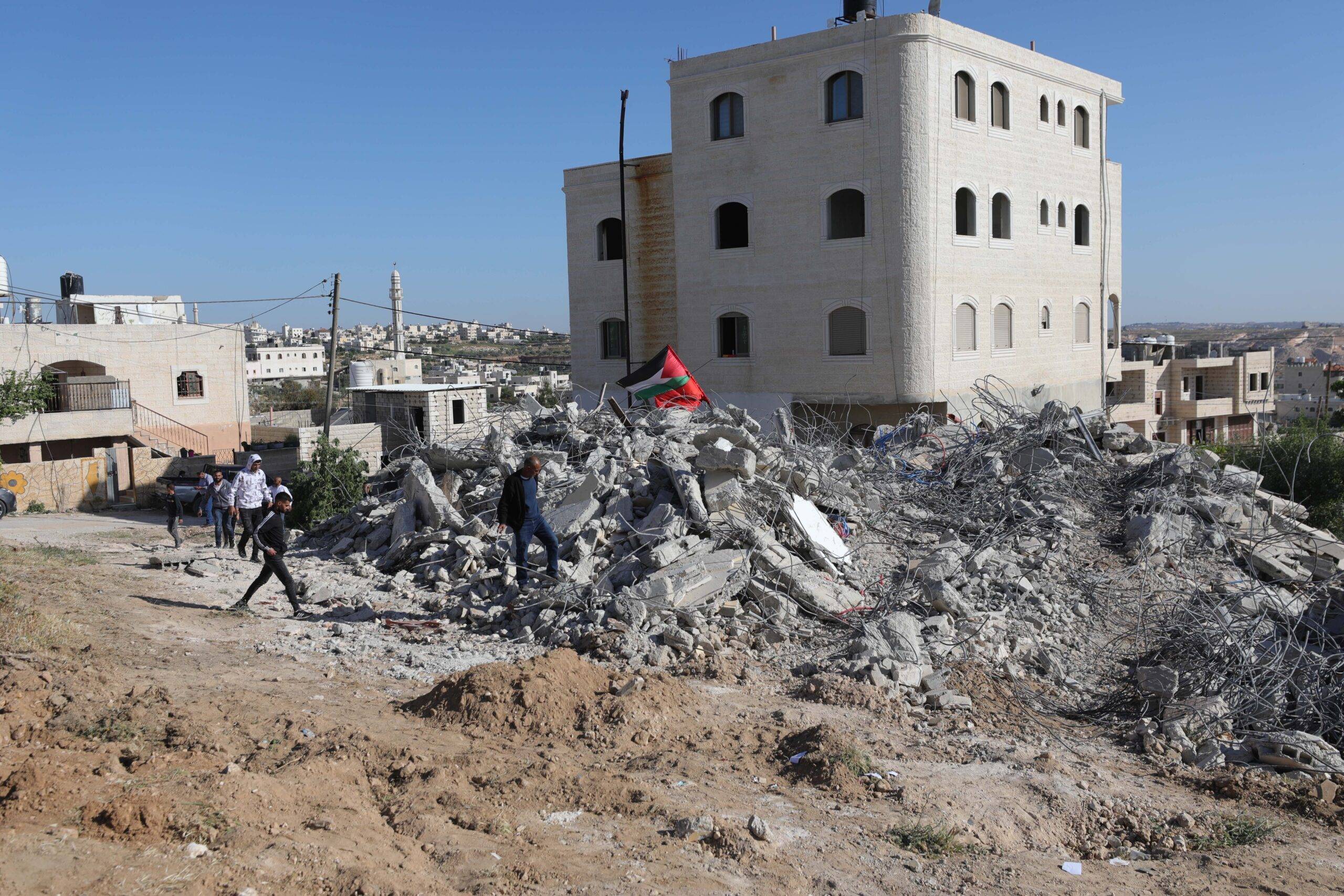
- On Tuesday 27 July, around 1500 Israeli police together with 'community volunteers' and bulldozers razed the Palestinian village of Al-Arakib, in the Negev Desert.
- About 45 homes were completely destroyed, leaving more than 300 Palestinians homeless.
- Alongside their homes being razed, hundreds of olive trees were uprooted and orchards destroyed to pave way for the Jewish National Fund forest.
- The Israeli officials claimed that the village was built illegally but a recent study shows that Israeli Palestinians have been forced to build illegal housing due to the government's refusal to recognise their communities as 'official towns' and subsequent refusal to grant them building permits.
- The study compiled by attorney Kais Nasser states, "The Arab citizen in Israel does not suffer from a 'syndrome' or find pleasure in illegal construction… Like any citizen of the state, the Arab citizen would build legally if he were guaranteed within a planning framework that enabled him to receive a permit."
- The Israel Land Administration (ILA) stated that it would stop any further attempts to rebuild the village and "should they return, we shall do it again".
Gaza Blockade
A moving insight into the stresses of everyday life in Gaza was published in the New York Times.
- The lack of jobs affects whole families, not just the unemployed men. Their wives struggle to cope and their children see no future. "How could [the women] be expected to cook and clean without water or electricity? What could they do in homes that were dark and hot all day? How could they cope with husbands who had not worked for years and children who were angry and aimless?"
- The plight of Palestinian refugees is summed-up neatly: "homelessness, occupation, war, dependency". However, "The issue is not hunger. It is idleness, uncertainty and despair."
- The siege of Gaza has contributed to "a fractured and despondent society unable to imagine a decent future for itself as it plunges into listless desperation and radicalization".
- Unsurprisingly, "domestic violence is on the rise."
- Although "Israel is never far from people's minds here. Its ships control the waters, its planes control the skies. Its whims, Gazans feel, control their fate", feelings are mixed about Hamas and Fatah. One man describes them as "two sides of the same coin". Others blame the Palestinian Authority in Ramallah for their situation.
- "We believe in Israel's right to exist," says one man, "but not on the land of Palestine. In France or in Russia, but not in Palestine. This is our home."
Fallout from the 'Freedom Flotilla'
EU and blockade ease
- Israel released a limited list of goods banned from the Gaza Strip which will replace the list of allowed items in line with promises to "ease" the blockade. The list permits the import of building materials for projects authorised by the PA and implemented by the international community. Britain's Foreign Secretary William Hague stated that the list showed "that it is possible to lift the pressure on ordinary Gazans without compromising the security of ordinary Israelis" while shadow Middle East Minister Ivan Lewis stated that improving the situation in Gaza was crucial to building confidence for direct negotiations.
- The EU Commissioner Chris Patten said that the policy of blockading Gaza was "a terrible failure - immoral, illegal and ineffective" and had "deliberately triggered an economic and social crisis which has many humanitarian consequences." He asserted that it is time to reassess Hamas' isolation, with the EU taking a bolder approach on the Middle East. He also criticised US dominance implicitly and said that the relaxation of the blockade had not gone far enough with particular reference to the economic situation and the prevention of exports. However, while "easing" the blockade did not represent a fundamental shift in policy, it had deflated criticism.
Turkey
- According to Turkish media reports, Turkey is prepared to ban commercial flights to and from Israel unless its government adheres to Turkish demands for an apology for the families of the victims, compensation, an international inquiry into the incident and the full lifting of the blockade. Israel has refused all of these demands despite the increasing tension with what used to be their closest ally in the Middle East. Turkey has already banned a military craft from flying over Turkish airspace.
- A secret meeting was held between Israeli Trade and Industry Minister Binyamin Ben-Eliezer and Turkish Foreign Minister Ahmet Davutoglu in Brussels in an effort to mend badly damaged relations. No progress was made and Ankara appears to be holding to its demands and later threatened to completely break off diplomatic relations at a press briefing. The meeting caused a public rift between the Isreali PM, Benjamin Netanyahu, and his Foreign Minister, Avigdor Lieberman.
- Some analysts argue that despite the US being in no hurry to put pressure on Israel over the flotilla for its own reasons, Turkey's determined stance and demands may become counterproductive. Cutting ties with Israel would deprive Turkey of a relationship with both military advantages as well as one that has brought it leverage in the Middle East, particularly as a mediator, and it will lose diplomatic equilibrium that serves Turkish interests.
Inquiries into the Flotilla incident
- The military team appointed to investigate the IDF operation against the Gaza-bound freedom flotilla in May has found that a series of mistakes were made in the planning and intelligence gathering stages higher up the command but praised the commandos who took part in the attack. It said the mistakes were not due to negligence. The flotilla had not been prioritized as an intelligence target and the "violent intentions" of IHH had not been recognized. It claimed the first shot had been fired by IHH and Israel commandos only used lethal force in a selective manner. No personal recommendations were made.
- The UN Human Rights Council will launch an investigation into the flotilla incident aboard the Mavi Marmara following a decision made 48 hours after the flotilla was intercepted and before the Israeli inquiry was established. It will be headed by former president of the International Criminal Court, Canadian Philippe Kirsch, and will include international observers. Barack Obama is reported to have warned Turkey that an international inquiry could not be in its best interests. The Turkish Foreign Minister said that Turkey would accept an Israeli inquiry if it led to an apology and compensation.
- Spanish activists on board the Flotilla are to file a civil claim against Netanyahu, six government ministers and the commander of the navy. According to a Spanish newspaper, the three activists "claim they were subjected to light torture, were arrested in an illegal manner, and were expelled by force from Israel by Israeli authorities after the events on-board the Mavi Marmara."
- A Libyan aid ship was forced to dock at Al-Arish instead of Gaza. On board was a delegation from the Gadhafi International Charity and Development Foundation.
Freedom Flotilla and the US
A powerful commentary on the killing of a US citizen on the Mavi Marmara was written by NYT columnist Roger Cohen
- "Furkan Dogan... was proud of his American passport and dreamt of coming back after completing medical school. Five Israeli bullets - at least two of them to the head - ended that dream on May 31. Dogan was 19."
- The above is an extract from "the start of the story you haven't read about the short life of Furkan Dogan, an American killed by Israeli forces in international waters on the Turkish-flagged Mavi Marmara". Roger Cohen finds "the effacement of Dogan since his death almost two months ago at once offensive and instructive".
- He points out that if the victim had been "Hedy Epstein, a St. Louis-based Holocaust survivor, or Edward Peck, a former U.S. ambassador to Mauritania" then "we would have heard a lot more". (Epstein had planned to be aboard the flotilla and Peck was.) Or if an American with a more American-sounding name had been killed by a Palestinian the media would have been "deluged" with stories about him.
- "But a chill descends when you have the combination of Israeli commandos doing the firing, an American with a foreign-sounding Muslim name, and the frenzied pre-emptive arguments of Israel and those among its U.S. supporters who will brook no criticism of the Jewish state."
- Reference is made to criticism of Israel by American-Jewry who tend to check-in "their liberalism at Zionism's door".
- Nobody in Congress has, apparently, made any comment about Dogan's killing. The spokesman of the Congressman for the area where Dogan used to live said, "There really isn't much of a local connection here"; the Congressman himself "had no comment".
- Dogan's father told the Wall Street Journal that if his son had been a Christian there would have been a different response: "I know what people do there [in America] when a cat gets stuck in a tree."
- "It's different, however," writes Roger Cohen, "when an American Muslim male gets stuck in a hail of Israeli gunfire."
Gilad Shalit campaign
- A 12-day march to Jerusalem, led by the parents of the captured soldier Gilad Shalit, took place aimed at forcing the Israeli government to agree a prisoner swap that would secure the soldier's release "at any price". Thousands joined the march, including two cabinet ministers from the right-wing religious Shas party, which culminated in a rally in the city's Independence Park. Shalit's father has vowed to remain camped outside the PM's residence until a deal is secured.
- Labour Friends of Israel Chair Andrew Gwynne MP, LFI Vice Chair Louise Ellman MP, David Cairns MP and Lord Janner of Braunstone met with the FZY organisers of a weeklong vigil outside of Number 10 Downing Street held to gather support for the campaign. They signed a petition calling for Shalit's release and for Hamas to permit the International Committee of the Red Cross to visit him, condemning Hamas as being in breach of the international Human Rights Convention and as an obstacle to peace in the region.
- Israeli interior minister, Eli Yeshai said he was prepared to meet Hamas to secure the soldier's release. Israeli Prime Minister Benjamin Netanyahu said he would be willing to release approximately 1,000 Palestinian prisoners in a swap but drew the line at paying "any price"; he ruled out the release of "arch-terrorists" and insisted that those released be deported either to Gaza or completely outside the Occupied Territories. The soldier's family has criticized the stance as a recycling of the Ehud Olmert position.
And in other news...
International; Britain, the US & the World
- In an obituary on her blogspot to the late Sheikh Muhammad Hussein Fadlallah, the head of Shia Clergy in Lebanon and known for his outspoken stance on Israel and terrorism, British Ambassador to Lebanon Frances Guy described the sheikh as her "favourite politician". She wrote, "When you visited him you could be sure of a real debate, a respectful argument and you knew you would leave his presence feeling a better person." Her remarks sparked anger and condemnation in the Jewish community. A foreign office spokesperson later said that after "mature consideration", her post was taken down. She has since written that it was not her intention to upset anyone.
- CNN Middle East Editor Octavia Nasr was fired for a lack of "impartiality" after tweeting, "Sad to hear of the passing of Sayyed Mohammed Hussein Fadlallah... One of Hizbollah's giants I respect a lot." Nasr explained later that her simplistic comment failed to convey that her admiration was based on his relatively progressive stance on women's rights and not his life's work. The American Jewish Committee demanded an apology.
- Uri Brodsky, an alleged Israeli Mossad agent involved in the Dubai assassination has been given three days by Polish authorities to appeal against his extradition to Germany for obtaining a genuine German passport using a fabricated story of Nazi persecution.
- In a rare instance of German criticism of Israel, a unanimous cross-party Bundestag motion condemned Israel's attack on the flotilla in May. The motion, which demanded that Israel end the siege while condemning arms smuggling and rocket attacks against Israel, suggests a change in Germany's usually unquestioning stance on the state. The Coordinating Council of German Non-governmental Organisations against Anti-Semitism has suggested that the Bundestag motion is merely a polite form of anti-Semitism and others have criticized it as one-sided in favour of Hamas. It could undermine Germany's official commitment to Israel's security (1949). In the wake of an increase in apparently anti-Semitic attacks in Germany, Polish-born, German-Jewish columnist Henryk Broder said in Der Spiegel that the real point of last week's unanimous Bundestag vote was to cement a national identity.
- The organisers of Toronto's annual Gay Pride parade have reversed the decision to ban the use of the term "Israeli apartheid". The initial debate was sparked by a group of local activists calling themselves Queers against Israeli Apartheid (QuAIA) announced their intention to march in the parade. Allegations of censorship and anti-Semitism have raged back and forth ever since.
- Fenton communication, a US PR firm with links to the Obama administration, has decided not to renew a $240,000 contract for Al-Fakhoora, which campaigns to break the siege on Gaza and participated in the freedom flotilla. The decision came following Jewish complaints.
- There have been calls for a re-trial in the case of the "smash-EDO" group of seven activists cleared of damaging an arms factory, following the release of the judge's summing-up comments. Judge George Bathurst-Norman told the jury that the group's leader should be awarded the George Cross for his campaign when the group claimed they acted to prevent Israeli war crimes. The judge has been accused of having an anti-Israel agenda and that a mistrial should be declared.
- Responding to questions on changing British universal jurisdiction laws, the Justice Secretary, Kenneth Clarke, announced that the coalition government will act "at the first opportunity" to change the law on universal jurisdiction for war crimes. It will table a legislative amendment which will require the consent of the Director of Public Prosecutions before an arrest warrant can be issued, in response to any private prosecution for war crimes. It is expected that the amendment will be introduced in September, when Parliament returns from its summer recess. Conservatives campaigned on a promise to reform this law, although the Lib Dems made their opposition to this clear during the election campaign. Organizations such as the Palestinian Solidarity campaign are outraged at the government's plans. Sarah Colborne, the PSC's director of campaigns and operations, accused the "cynical coalition government" of "bending over backwards to welcome Israeli leaders to this country". She said, "How much lower can Cameron and Clegg stoop? If this legislation is passed, it will affect not only the people of Palestine, but victims of war crimes around the world. It must be stopped there should be no safe haven for war criminals here."
- A group of 91 Israelis and North Americans who claim to be victims of Hezbollah rocket attacks in the 2006 war have begun legal action against al-Jazeera claiming that their real-time broadcasts enabled the group to strike more accurately and that the intention of the television station was to assist in the targeting and killing of civilians. The group is seeking around $800 million in damages at the New York Federal Court. This is not the first time that supporters of Israel have abused US law to make outrageous claims against third parties.
Palestinian members of the Israeli Knesset speak at MEMO event:
- On Wednesday 28th July, the Middle East Monitor (MEMO) and the Palestinian Solidarity Campaign (PSC) hosted a groundbreaking and highly successful public event in the Houses of Parliament in Westminster.
- The special guests were Palestinian members of the Israeli Knesset (parliament) who brought the plight of Arab citizens of the state of Israel to the attention of the British people, particularly our parliamentarians.
- Dr. Jamal Zahalka, Miss Haneen Zoubi and Mr. Talab Al-Sana gave eye-opening and impassioned accounts of the daily battles fought by their community for equality and basic civil rights in the face of the legalised discrimination that blights every aspect of their lives.
Israel, the West Bank and Gaza
- Seth Freedman wrote an article in the Guardian earlier in the month about the courageous and tireless campaigner Ilana Hammerman, an Israeli journalist facing prosecution and a two year jail sentence for violating the "law of entry into Israel" after taking 3 Palestinian girls on a day trip to Tel Aviv. Her intention was to highlight the injustice of Israel's military occupation of the West Bank and to "raise certain in-depth public discussions in Israel's society", particularly with regard to the caged existence of their neighbours. Hammerman believes that her own liberty is worth sacrificing to assist in the Palestinian struggle and she has been described as "one of the great Israelis of our time". Her efforts and those of other Israelis like her are vital in bridging gaps and building a lasting peace.
- An IDF sniper has been charged with manslaughter for shooting dead two Palestinian women during the war in 2008/9. The two women were waving white flags when they were shot.
- A video tape was released recently which reveals Benjamin Netanyahu's true opinions about the Palestinians and the US administration and his contempt for the peace process.
| < Prev | Next > |
|---|


Boycott, Divestment and Sanctions campaign